Overview
Introduction
One of the key needs in any open computing environment is a computable representation of its own models, for a number of purposes, including reasoning about them, performing validation and consistency checking, building software and generating documentation. This is particularly true of openEHR, where a further need is to be able to validate archetypes and templates with respect to the reference model, and also to validate runtime instance data against operational templates and the reference model.
A number of computable representations of the openEHR published models have been available in the past. Currently models are represented in two computable forms:
-
MagicDraw 18.5 or higher UML/XMI;
-
Basic Meta-Model (BMM) format, i.e. the format of this specification.
The primary use of the UML expression is for specification publishing. In this role, the internal UML is processed to generate correct signatures for class properties and functions, and can be used computably for other purposes, as long as care is taken with template and qualified attributes.
The BMM provides a standalone alternative to UML/XMI which correctly represents all types, including open and closed template types, and is human-readable. It was originally developed in 2012, when the state of UML tools and particularly XMI was poor, and a reliable format was needed for openEHR modelling tools.
| Other than for working with particular tools designed to use BMM, BMM is not a required formalism for implementing openEHR, and other methods of accessing models computably may be used, including UML and software implementations of the openEHR Reference Model. |
Current State of the Art
One would expect that the ICT industry would have fully computable representations of models and diagramming solved, but it is not yet the case. UML 2.x and its associated serialisation format XMI 2.x should in theory mean that complete, interoperable machine expressions of object models would be available in all tools. It will probably eventually come to pass, but a number of obstacles remain to date:
-
the UML 2.x specifications are exceedingly complex (see OMG site for specifications; UML 2.1.2 'superstructure' = 738pp; UML 2.1.2 'infrastructure' = 224pp);
-
the XMI 2.x specification is correspondingly complex, which seems to have so far prevented reliable tool interoperability (recognised as a critical issue by OMG in 2015);
-
the Design By Contract (DbC) concept is supported via the use of OCL 2.0 constraints in class models, although there are semantic holes, e.g. proper semantics through inheritance;
-
for some, XML schema represents a way of expressing object models, but in fact is not semantically suitable for this purpose, primarily due to its different inheritance model. It can be and is used (including in openEHR) as a derivative serialisation representation, but from the point of view of specification, it is deficient in having non-object-oriented inheritance semantics, no generic classes, no representation of non-data members, and only marginal support for design by contract.
Experience with various UML tools (up till 2015) highlighted the following problems:
-
poor support for OCL and design by contract in most tools;
-
variable support for generic (i.e. template) classes; even those tools that properly implement the UML 2.5 specification are still very hard to use for defining generic classes because of problems in the specification that remain unaddressed;
-
problems with qualified attributes, which are used to represent identifier references to objects rather than direct references;
-
variable support for XSD generation across tools, where the results are wildly wrong in some tools;
-
in some tools, it is impossible to define an abstract formal model - the only option is to select a particular programming language profile such as Java or C# and thus get locked into the limitations of those languages (messy type systems, weak inheritance semantics, language-specific notion of types such as
Array<T>,List<T>, etc.).
Since 2015, the quality of some UML tools has improved, and the XMI generated by some is more reliable. However, XMI generated by different tools is not the same for identical models, and some XMI importers offer numerous switches in order to process the XMI of another tool properly. XMI thus still needs to be processed with care.
Nevertheless, a small number of tools, including MagicDraw (currently used for representing openEHR models for the specifications) and Rational Software Architect (RSA), appear to implement UML 2.5 faithfully. This means that despite the limitations of UML 2.5 (as noted above), models expressed in it can be correctly interpreted and processed for purposes such as code generation.
| Other tools may well perform as well or better, and in any case, all tools change over time. No endorsement of a particular tool is intended here. |
Design
The Basic Meta-Model supports the representation of object models in the data point of view. It is designed to enable both human authoring and machine extraction (e.g. from a UML tool or programming language classes) of textual schemas. This specification defines a BMM object model, i.e. the in-memory object structure of a BMM, and also an object model for a serialised schema form. The latter enables serialisation of a BMM into a concrete syntax such as ODIN, JSON or XML. In the future an abstract syntax serialisation may be developed in the style of OMG IDL (Interface Definition Language) or similar.
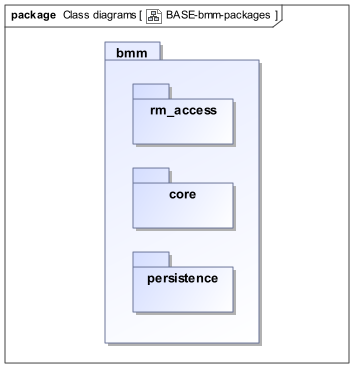
The BMM packages are as follows:
-
rm_access: the interface to most features including schema load/reload, generally used by an application as a reflection library; -
core: the core BMM classes used for in-memory representation of an object model; -
persistence: a simplified version of the core classes prefixed withP_BMM_, used for persistence and human authoring, which allow file (i.e. schema) inclusion and re-use.
The P_BMM_* classes perform two functions. Firstly, they are a modified and simplified version of the BMM_* classes that enable for example symbolic referencing via class names, syntactical type names to be used etc, rather than the full explosion of fine-grained objects that would result from a direct serialisation of BMM_* classes. This is what enables the P_BMM file format to be easily readable and editable by human users.
The second is that P_BMM files function as schemas that support schema inclusion and therefore re-use, in a similar manner to the XML schema languages. Thus, a single logical BMM model can be expressed as a number of P_BMM schema files which are actually P_BMM_* object serialisations. A schema reading component has to resolve the schema inclusions and ultimately BMM_* object instantiations to obtain the in-memory form of the model.
We thus talk of the P_BMM_* classes as a model of 'BMM schemas' and the BMM_* classes as a model of 'BMM models', where the latter is understood as the fully computable in-memory object structure with all name references resolved to object references.
The packages are illustrated below.
The normal use of BMM is as follows:
-
create a P_BMM schema in the form of one or more files, using the
P_BMM_form of the model. This is easy to understand by copying existing examples; -
locate these files in a suitable place for use with a tool such as the openEHR ADL Workbench and LinkEHR.
Schema Format
BMM models are normally expressed as schema text files that support inclusion and re-use. The default file format has historically been openEHR ODIN syntax, and BMM tools to date support this format. However any common format that can express typed object models may be used, including JSON (with type markers), YAML, and XML. The examples shown in this specification are primarily in ODIN, but a tool implementing BMM may choose to serialise in and out of another preferred format.
A Note on Language
The elements of meta-models are sometimes named confusingly in the literature and within various programming language technologies. In this specification, we have used the following terms:
- feature (of a class)
-
any stored or computed element of a class, including constants, attributes (properties) and routines (methods);
- property
-
a stored class feature; also known as 'attribute';
- routine
-
a computed class feature that may be either value-returning (a function) or work-performing (a procedure);
- function
-
a routine that computes and returns a value; typically causes no side-effects in the object;
- procedure
-
a routine that performs a computation; typically has side-effects;
- generic (class or type)
-
a kind of class or type that has parameters of other types; known as 'template' type in some programming languages.